
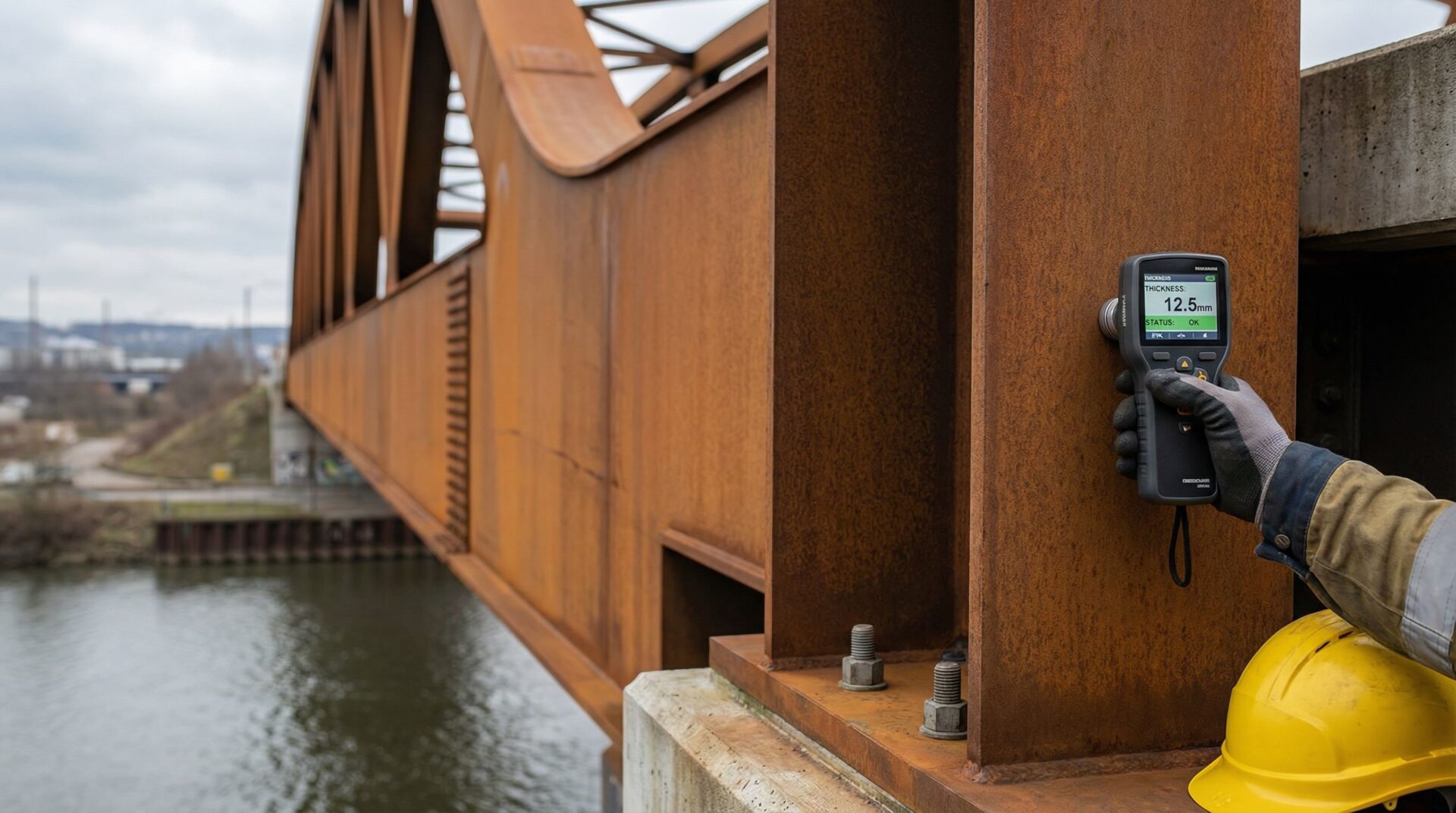
Metallurgy and structural performance
The performance of QWERNOX is the result of carefully controlled metallurgy combined with advanced plate rolling technology.
Its alloy composition and processing conditions are specifically designed to promote protective patina formation while maintaining structural mechanical properties.
Corrosion mechanism
In atmospheric conditions, oxygen and moisture initiate oxidation reactions on the steel surface. In conventional steels this oxidation continues indefinitely, gradually degrading the material.
Weathering steels behave differently.
Alloying elements such as copper and chromium promote the formation of a dense and adherent oxide layer that significantly slows further corrosion.
Once stabilised, this patina acts as a barrier that protects the underlying steel.
Chemical optimisation
The chemical composition of QWERNOX is carefully controlled to achieve both corrosion resistance and mechanical reliability.
Key alloying elements include:
• Copper and chromium for atmospheric corrosion resistance
• Niobium and titanium for grain refinement
• Controlled carbon equivalent to maintain weldability
Each production mill optimises its chemistry according to its production route, ensuring reliable mechanical properties across a wide range of plate thicknesses.
Rolling technology
QWERNOX plates are produced using advanced quarto plate rolling technologies.
Controlled rolling conditions ensure consistent mechanical properties, refined microstructure and excellent dimensional accuracy.
Depending on grade and thickness, plates may be produced using:
- Furnace Normalised or normalised rolling (+N)
Producing a homogeneous ferritic-pearlitic microstructure with reliable toughness. - Thermo-Mechanical Controlled Processing (TMCP)
Improving strength and toughness through controlled deformation and cooling. - Accelerated Cooling (ACC)
Ensuring uniform properties across thick plates and reducing residual stresses.
Weldability
Weldability is a key requirement for structural steels used in large engineering projects.
QWERNOX steels are designed with controlled carbon equivalent values to ensure predictable welding behaviour.
Typical CEV values below 0.45% allow reduced preheating requirements and facilitate reliable welding procedures.
Testing including CTS and Bend-on-Plate confirms good resistance to cracking and excellent post-weld ductility.